Limited Stock! Your Cart is Reserved for [X] Minutes
Top Vascular Specialist Reveals the Truth About Pregnancy Veins That No One Tells You…


WARNING: If you're pregnant and a vein has started showing on your calf or behind your knee that wasn't there a couple of months ago, stop and read this before you close it. There is a narrow window to keep that vein from becoming permanent, and it slams shut the day you give birth. This page comes down in 72 hours, and I'll tell you why at the end.
I'm about to make every vein clinic and laser center in the country very uncomfortable. Good. They've had it coming for a long time.
My name is Dr. Elise Moreno, and I remove veins for a living. Fifteen years of it. Which means I'm the last stop, the person women come to once it's already too late, once the only thing left to do is burn the vein out with a laser and hand them a bill their insurance won't touch.
And after fifteen years, I've finally had enough of watching it happen to women who never needed to be in my chair at all.
THE WOMAN IN MY CHAIR LAST TUESDAY

Let me tell you about last Tuesday.
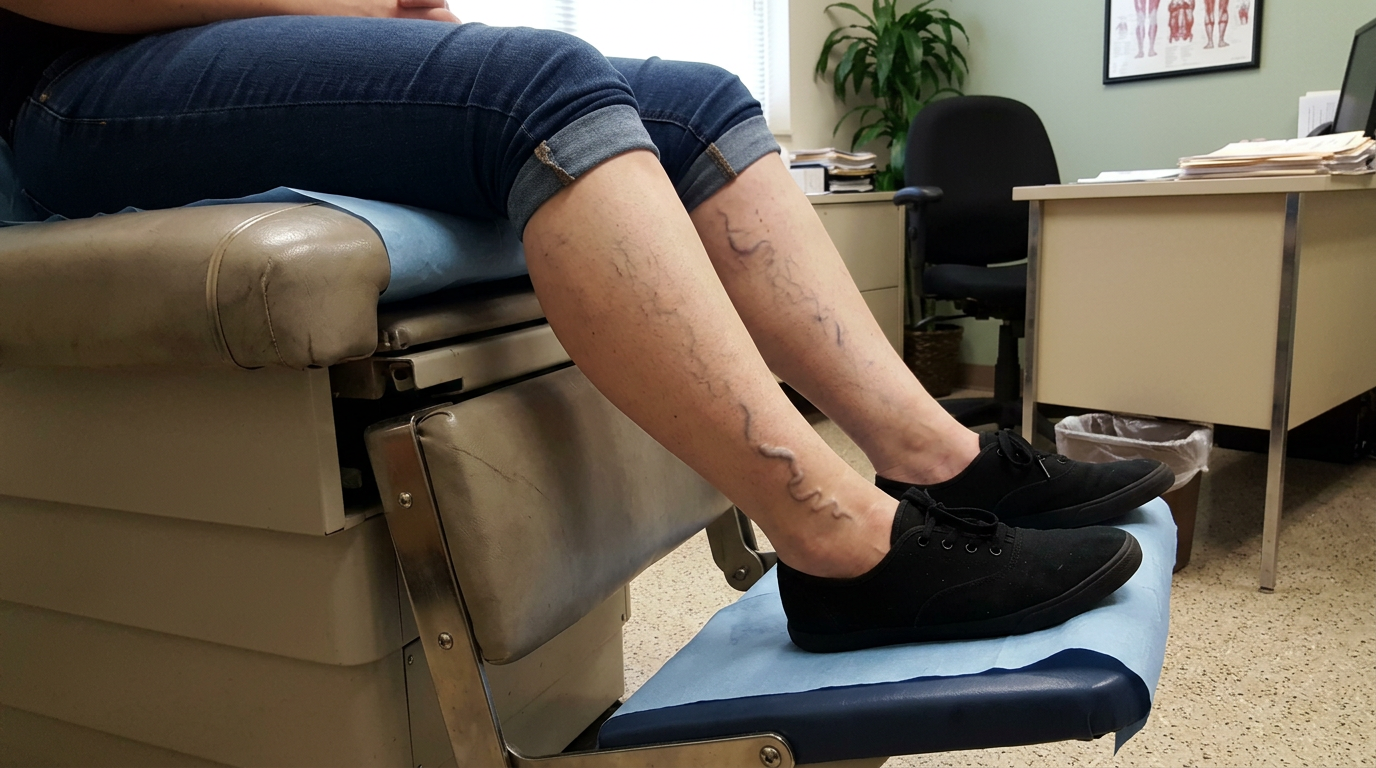
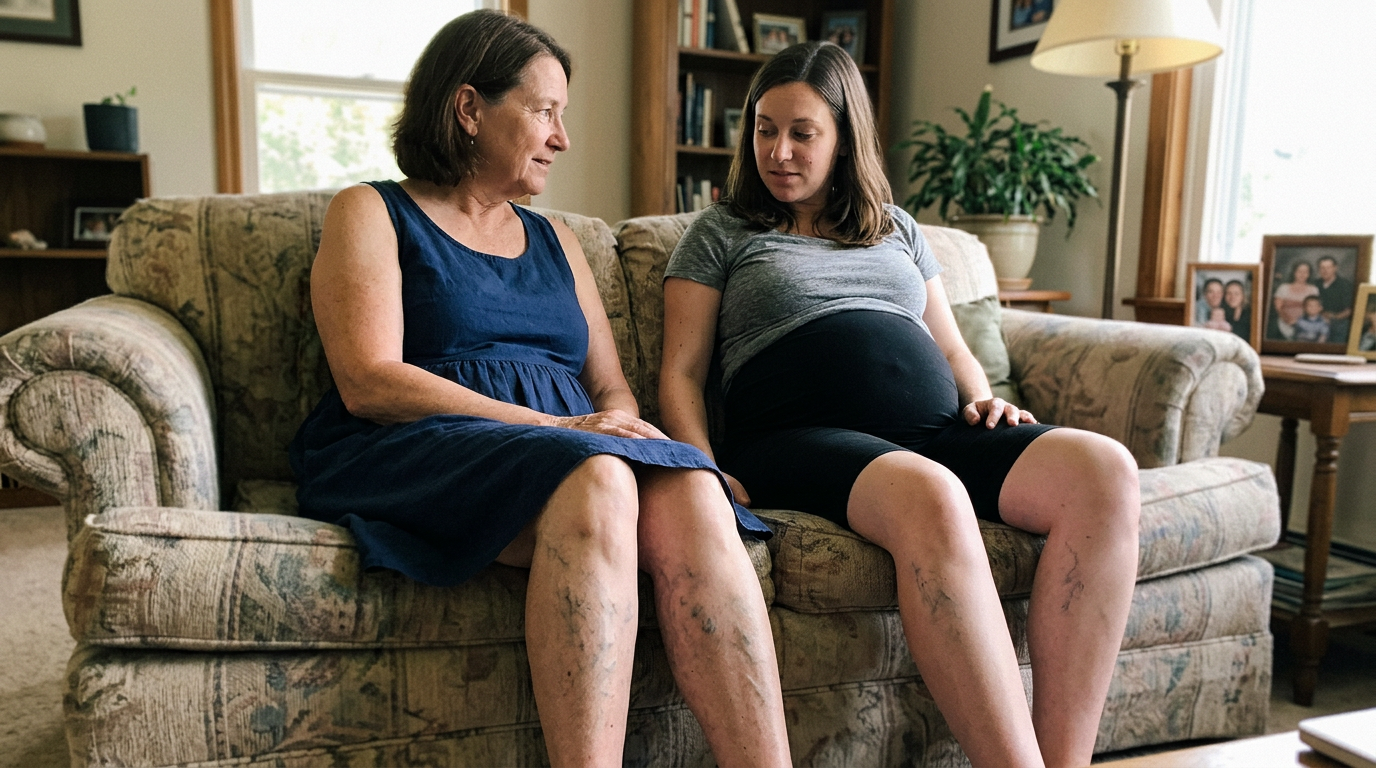
A woman sat across from me, thirty-one years old, six months after her second baby. She was composed, right up until she wasn't. She rolled her jeans past her knees and turned her legs toward the light, and there they were: thin purple ropes fanning out behind both knees and curling down toward her ankles. The same pattern her mother has had since her fifties, she told me. She'd spent the whole summer hiding them.
She asked me the only question anyone ever asks in that room. "Can you make them go away?"
I could. Sclerotherapy in the small ones, laser ablation in the larger. Three, maybe four sessions. A little over four thousand dollars, out of her own pocket, because a vein on a young mother's leg is filed as "cosmetic," and no insurance company in this country will pay a cent toward it.
But the money wasn't what got her. When I explained that these veins had formed during her pregnancy, and that the one window to keep them from setting had closed months ago, before she'd even really noticed them, she went quiet. Then she said, "Nobody told me. Not once. Not at a single appointment."
And she cried. Not about the veins, and not about the cost. About the fact that it had been avoidable the entire time, and no one had said a word.
AND SHE IS NOT RARE
I wish I could tell you she was unusual. She isn't. I see some version of her every single week.
Here is a number almost no one says out loud: by most estimates, up to 84% of mothers are left with varicose or spider veins after pregnancy. Eighty-four out of every hundred. And almost none of them were ever told why it happens, or that there was a stretch of a few months when they could have done something about it.
Sit with that. It is one of the most common lasting changes pregnancy makes to a woman's body. It is one of the most preventable. And it is the one nobody explains until she's sitting in front of me asking me to undo it.
That is not an accident. By the time you finish reading this, you'll understand exactly why the people who profit from these veins are in no rush to warn you about them. But first you need to see what's actually happening inside your legs right now, because once you do, you can't unsee it.
WHERE ALL THE EXTRA BLOOD GOES

Start with a fact that surprises almost every patient I explain it to.
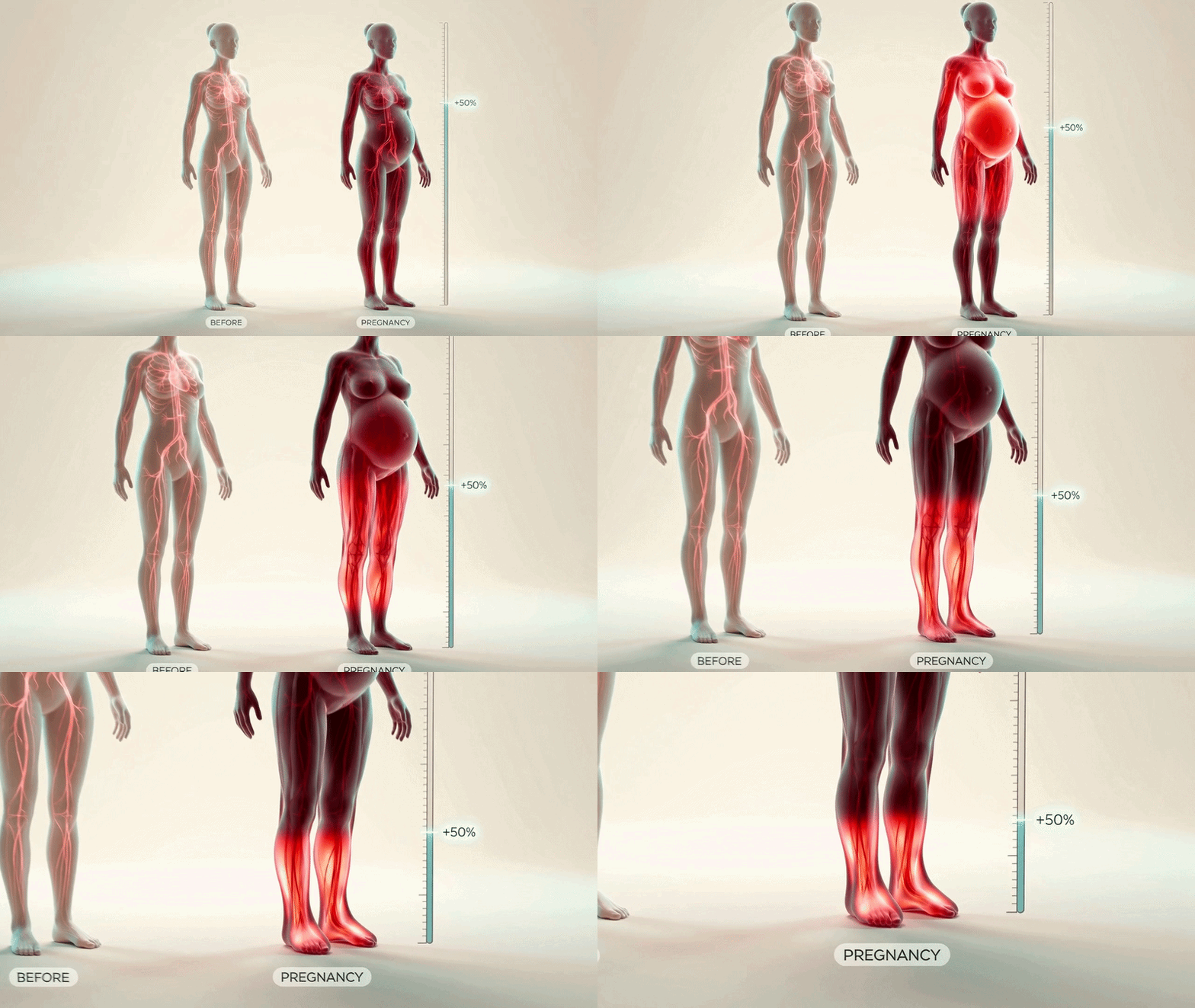
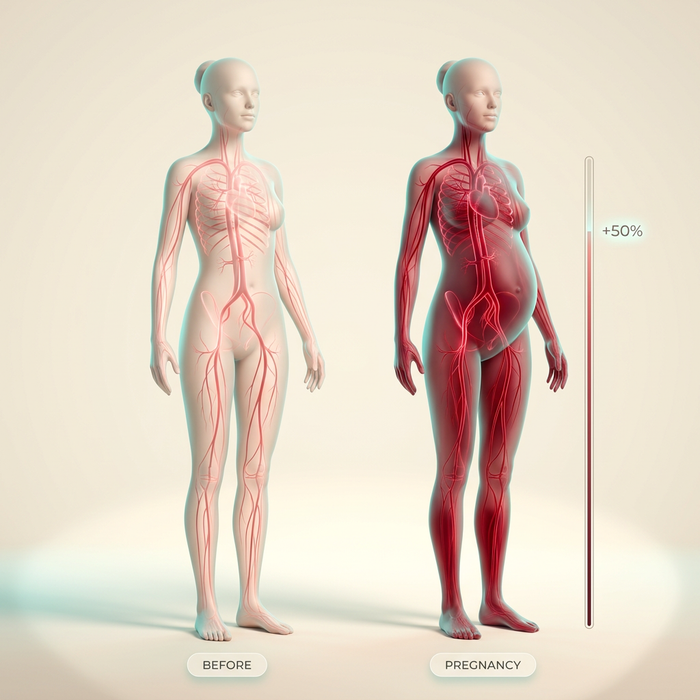
By your third trimester, your body is carrying close to 50% more blood than it did before you were pregnant. That isn't a problem, it's the opposite, it's how your body feeds and protects your growing baby. It's a sign of a healthy pregnancy.
But all of that extra blood has to go somewhere, and gravity decides for it. Every drop gets pulled downward, into your legs, all day long.
Then there's the baby. As it grows, it presses down on the large veins deep in your pelvis, the ones your legs rely on to send blood back up to your heart. Picture standing on a garden hose: the water behind the kink has nowhere to go, so it backs up. That is exactly what happens to the blood trying to leave your legs.
So it pools in your lower legs, and it sits there. Not for an hour. For months, every day you're on your feet.
WHY A VEIN COMES TO THE SURFACE, AND STAYS THERE

Now here's the part that decides whether you keep those veins for the rest of your life. Read it twice.
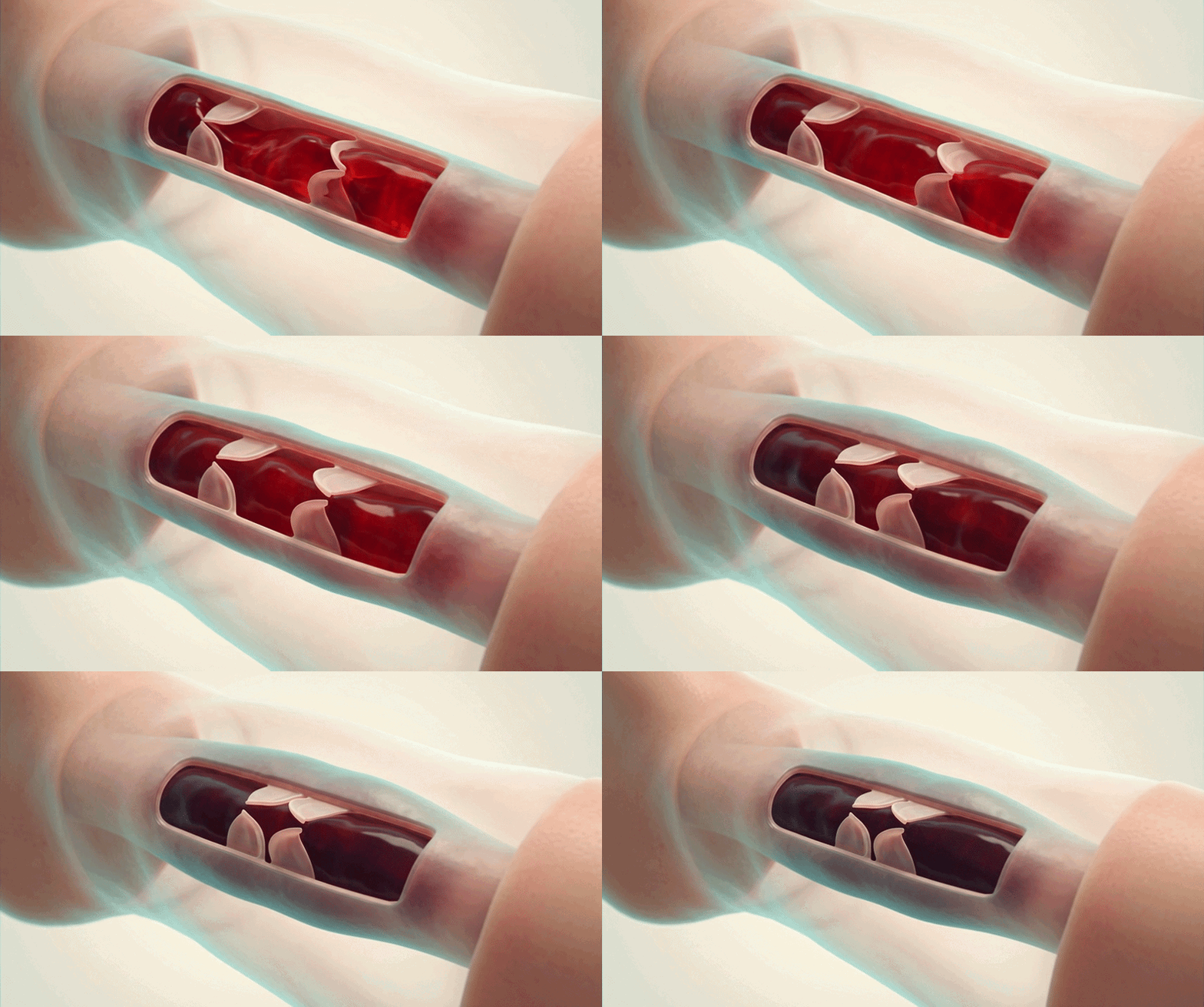
A vein is not a solid pipe. It's a soft, flexible tube, and running up the inside of it is a series of tiny one-way valves, little paired flaps that open to let blood climb toward your heart and snap shut behind it so it can't fall back down. Those valves are the only reason blood travels up your legs against gravity instead of pooling at your feet.
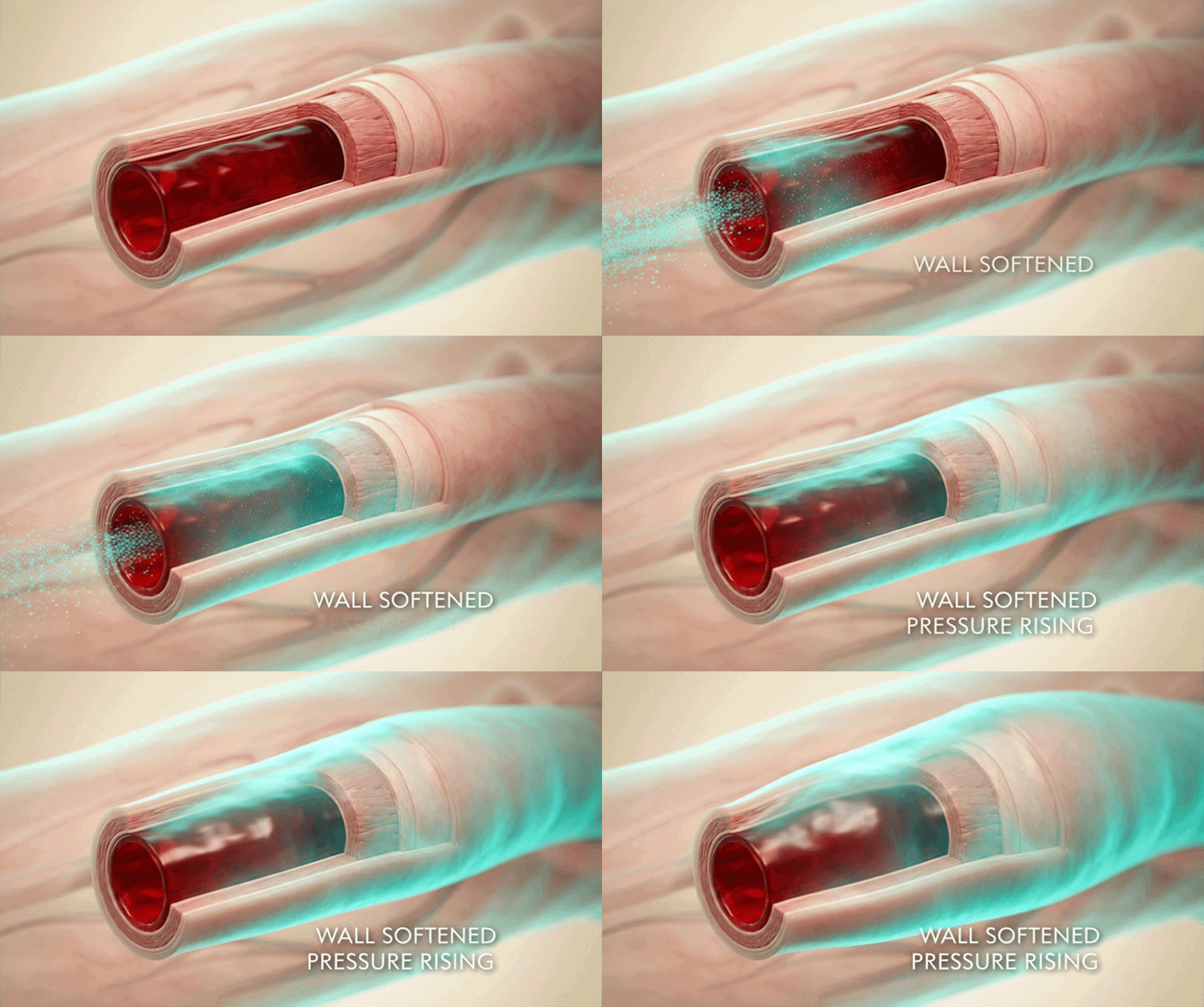
Take that pool of extra blood, sitting under pressure, and hold it against those valves for months on end. The vein wall is soft. Under constant pressure it stretches, the way a balloon stretches and never quite returns to its original size. And once the wall has stretched too wide, the valve flaps can no longer reach each other to close.
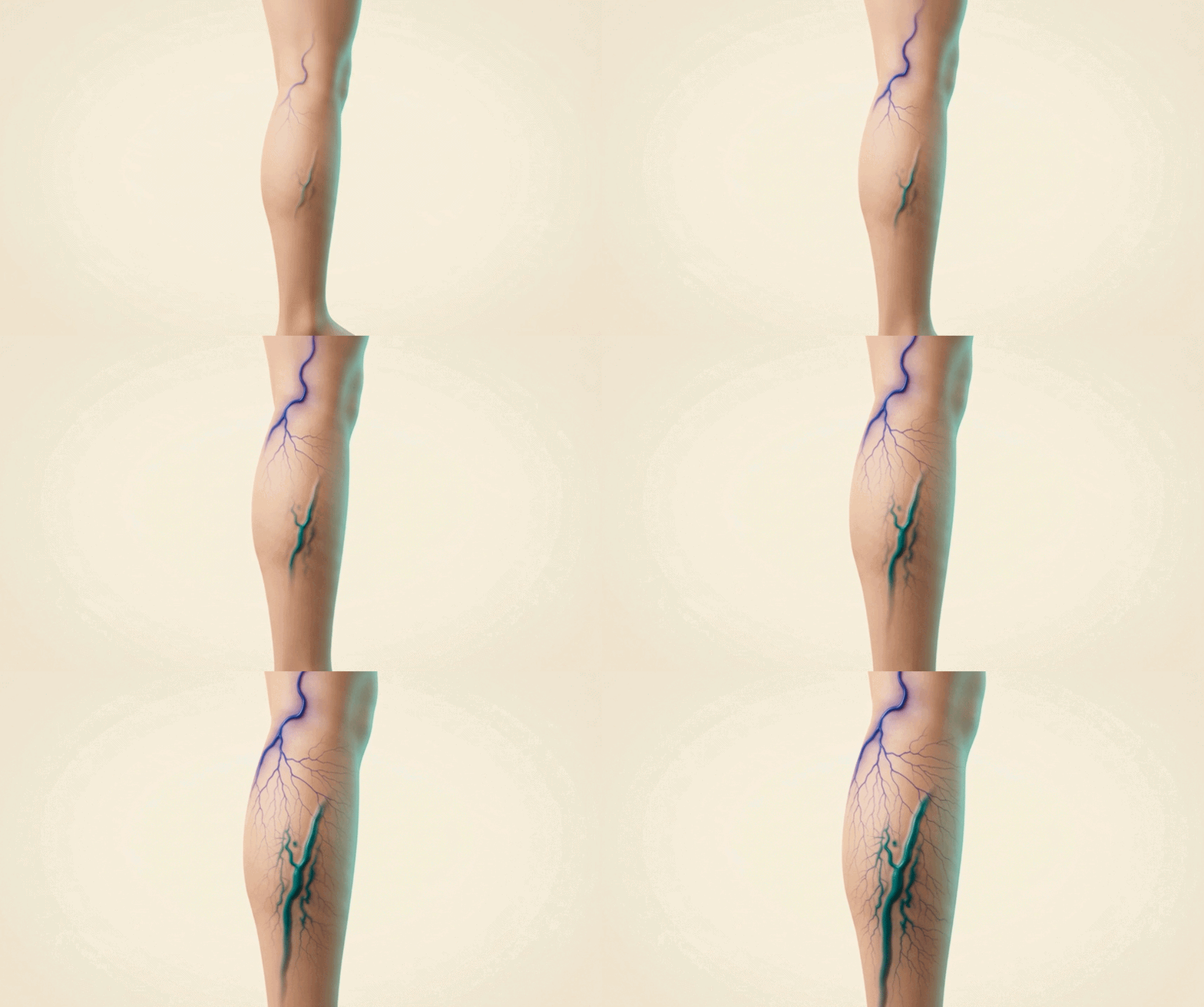
Now blood leaks backward through the gap. It pools even more. The pressure climbs. The vein swells and pushes up toward the surface until you can see it through your skin, a raised, twisting, blue-purple line.
That's the vein you catch in the mirror one night that simply wasn't there before.
IT'S NOT JUST THE BLOOD, IT'S THE HORMONES

There's a second reason pregnancy is so hard on your veins, and almost no one explains it.
To carry a baby, your body floods itself with hormones, progesterone in particular. Progesterone does dozens of necessary jobs, and one of them is relaxing smooth muscle throughout your body. That's what loosens your joints and softens your ligaments to make room for the baby.
But the walls of your veins are made of that same smooth muscle. So while all that extra blood is pushing outward on your vein walls, those walls are being chemically softened and relaxed at the exact same time. It's the worst possible combination: more pressure than ever, on walls that are more stretchable than ever.
That's why a vein can surface in seven months of pregnancy that would have taken thirty years of ordinary standing to appear. It isn't that your body is failing. It's that pregnancy stacks every risk factor for a stretched vein on top of each other, all at once, for months. Understanding that is the difference between blaming yourself and actually doing something about it.
WHAT THE CLINICS DON'T WANT YOU TO KNOW
Here is the most important sentence on this page, and it's the one the clinics keep buried.
The swelling and the vein are two different things, on two different timelines.
After you deliver, your blood volume drops back down, and the swelling goes with it. Your ankles come back. Your shoes fit again. That part is temporary, and it's the part everyone means when they promise "it goes away after the baby."
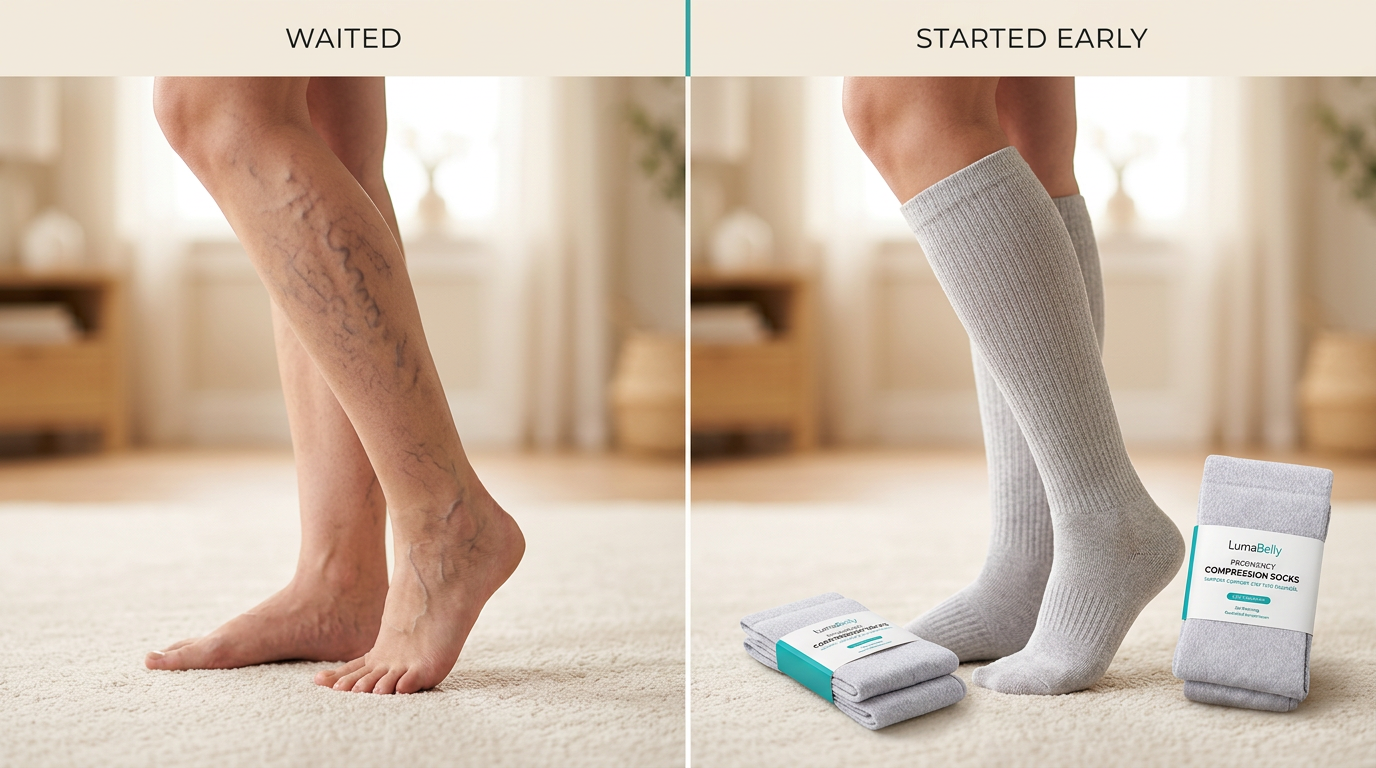
But a vein is not swelling. A vein is a wall that has already been stretched past the point of return. When the swelling leaves, the stretched vein stays exactly where it is. Permanently.
So when you're told "don't worry, it goes away," you're being told the truth about the half that was always going to leave on its own, and absolutely nothing about the half that stays forever. And the half that stays is the only half that ever needed a decision from you.
WHO THIS HITS HARDEST

Not everyone is at equal risk, and it's worth knowing where you stand, because the higher your risk, the more the timing matters. You're more likely to be left with lasting veins if:
Your mother or grandmother had them. Family history is the single biggest predictor. If the women in your family have varicose veins, you've inherited more stretchable vein walls, which means the pressure of pregnancy has an easier time doing its damage.
This isn't your first baby. Each pregnancy stretches the walls a little further, and the changes stack. A second or third pregnancy carries more risk than the first.
You're carrying twins or more. More baby means more blood volume and more pressure on the pelvic veins your legs drain into.
You're on your feet all day. Nurses, teachers, stylists, servers, anyone who stands for long stretches gives the blood more hours to pool, every single shift.
Or you sit for long stretches. Desk work and long flights are the opposite problem with the same result: hours of stillness where the calf never pumps the blood upward.
If two or more of those are you, this isn't a maybe. This is the part of your pregnancy most likely to leave a permanent mark, and the part with the shortest window to do anything about it.
VARICOSE, SPIDER, AND WHAT THEY BECOME

You'll hear two words for these veins, and it helps to know the difference.
Spider veins are the fine ones, thin red or purple webs sitting just under the skin, usually on the calves and thighs, sometimes behind the knee. They don't usually hurt. What they cost you is how your legs look, the reason women start reaching for the longer skirt and skipping the pool.
Varicose veins are the bigger ones, raised, rope-like, blue or green, that you can often feel as well as see. These ache, throb, and feel heavy by the end of the day, and they tend to get worse over time, not better.
Both come from the exact same thing: a vein wall stretched under pressure until its valves stop closing. Spider veins are that process on the small surface veins. Varicose veins are that same process on the larger ones underneath.
And here's what no one warns you: they don't simply appear and hold still. Left alone, the pressure tends to spread to the veins nearby, and what starts as one thin blue line at 28 weeks can widen into a web, or rise into a rope, over the years that follow. The best time to keep that from ever starting is the same narrow window we keep coming back to: while you're still pregnant.
THE "WAIT AND SEE" PLAYBOOK
So here's the question that should make you angry.
If the only chance to keep a vein from setting is while you're still pregnant, why is the one thing every pregnant woman gets told… "don't worry, it goes away after the baby"?
Because there is a fortune in the word "after." Watch how the trap runs, the same way every single time:
1. You notice a vein. You ask. You're told it's normal and it'll go away after the baby.
2. So you wait. You do the water, the feet up, the nothing that helps.
3. You deliver. The swelling leaves, right on schedule. The vein stays.
4. Now it's "cosmetic," so no doctor has to remove it and no insurer has to cover it.
5. A year later, you're the one writing a check for thousands to have it lasered off.
6. And the next pregnant mom walks in and hears the exact same sentence you did.
Round and round it goes.
FOLLOW THE MONEY

Once you see how the money moves, you can't unsee that either.
Removing veins is a large, quiet, extremely profitable business. Sclerotherapy, laser ablation, injections, follow-ups, and because a young mother's veins are "cosmetic," every dollar of it comes straight out of her own pocket, on repeat.
Here's the thing about that business. It only gets paid on one side of the timeline: after the vein has already set. There is no billing code for a mother who supported her legs at home with a $30 pair of socks and never developed the problem in the first place.
So think about what that does to the advice you're given. A mother who acts early, during pregnancy, is a customer they never get. A mother who "waits and sees" is worth thousands to them a year from now. When the entire financial incentive sits on the "wait" side, guess which advice survives.
To a vein clinic, you are not a patient. You are a laser appointment they haven't booked yet. Nobody has to lie for that to be true. The money simply, quietly decides which sentence you hear in that room. And the sentence is always "it goes away after the baby."
EVERYTHING YOU'VE TRIED, AND WHY IT DID NOTHING
By now you've probably tried the standard list, and noticed none of it does a thing for the vein. Here's why, one at a time.
Putting your feet up. It helps for about ten minutes, because while your legs are level with your heart, gravity stops pulling. The second you stand up to make dinner, it all rushes back. You cannot spend a pregnancy lying down.
Drinking more water, cutting salt. That shifts fluid around and changes how puffy your ankles look. It does nothing to the blood sitting inside the vein, and the vein is the problem.
Creams, oils, and "vein" serums. They sink into the top layer of your skin. The stretching is happening in a vein well below that. Nothing you rub on the surface will ever reach it.
Prenatal yoga and walking. Good for you, and genuinely good for circulation in the moment. But the pressure returns the instant you stop moving, which is most of your day.
Cold showers and elevation wedges at night. They feel nice, and they reset the swelling overnight. By lunchtime it's all back, because they do nothing while you're upright and living.
Cheap pharmacy compression socks. This is the one that makes women quit entirely. Most squeeze the whole leg the same top to bottom, so the blood has no reason to move up, it just gets trapped where it sits. And the few tight enough to feel like something are so hot and itchy you peel them off by lunch and never touch them again.
Every week you spend on things that can't reach the vein, the pressure keeps stretching that wall a little wider. The clock keeps running.

THE ONE THING THAT ACTUALLY MOVES THE BLOOD

There is exactly one thing that pushes that pooled blood up and out of your leg while you're standing up and living your day, which is the only time that matters. It's the reason your OB ever says the word "compression."
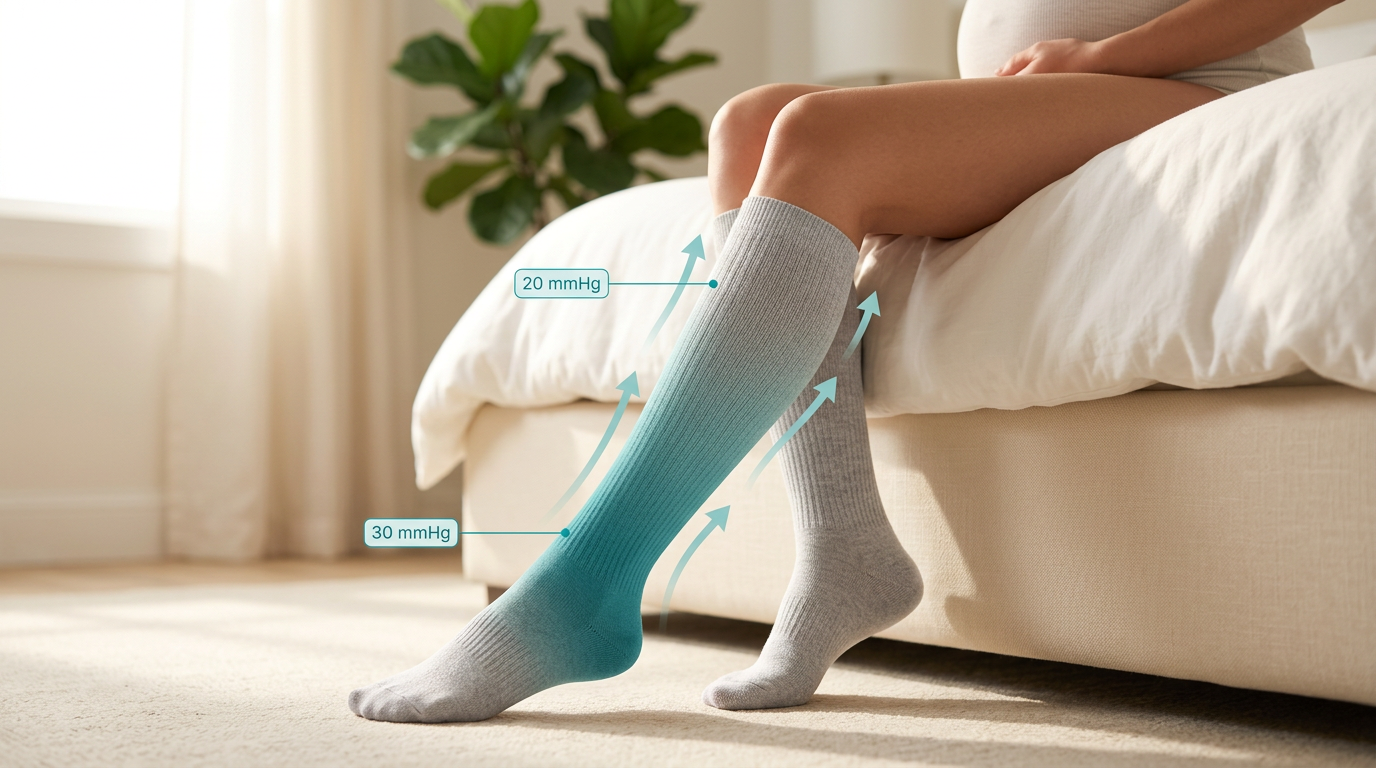
It's called graduated compression. "Graduated" is the whole point: the squeeze is firmest at your ankle and eases as it moves up your calf. That difference gives the blood one direction to go, up and out, instead of pooling at the bottom and stretching the vein all day.
It isn't new or exotic. It's the same principle behind the stockings they give people after surgery or for a long flight. What's different for you is that the support has to be built for a body carrying 50% more blood, and comfortable enough that you'll genuinely keep it on.
WHY THE NUMBER IS EVERYTHING
Here's where almost everything on the market falls apart. Two things have to be true, or graduated compression does nothing.
First, the pressure has to be strong enough for a pregnant leg. Here's the number nobody puts in front of you. Most compression socks sold in stores are 12 to 25 mmHg (that's the unit for how hard they squeeze). That range is built for a normal leg on a plane. It is not enough to move the extra blood of a pregnancy. To actually support a pregnant leg, you want 30 mmHg at the ankle, easing to 20 at the calf.
Second, it has to be a sock you'll actually keep on. The strongest sock in the world does nothing from inside a drawer. Almost every pair strong enough to work is so stiff, hot, and hard to pull on over a bump that it gets worn twice and abandoned.
So the sock that actually protects your legs is a very specific thing: strong enough for a pregnant leg, and soft enough to live in all day. Almost nobody makes that. I went looking anyway.
SO I WENT AND FOUND THE ONE THAT DID

I don't sell lasers and I didn't open a clinic. I went the other way entirely, and hunted down the one pair of socks that got all of it right, so any mother could do the one thing that works, at home, before her window closed.
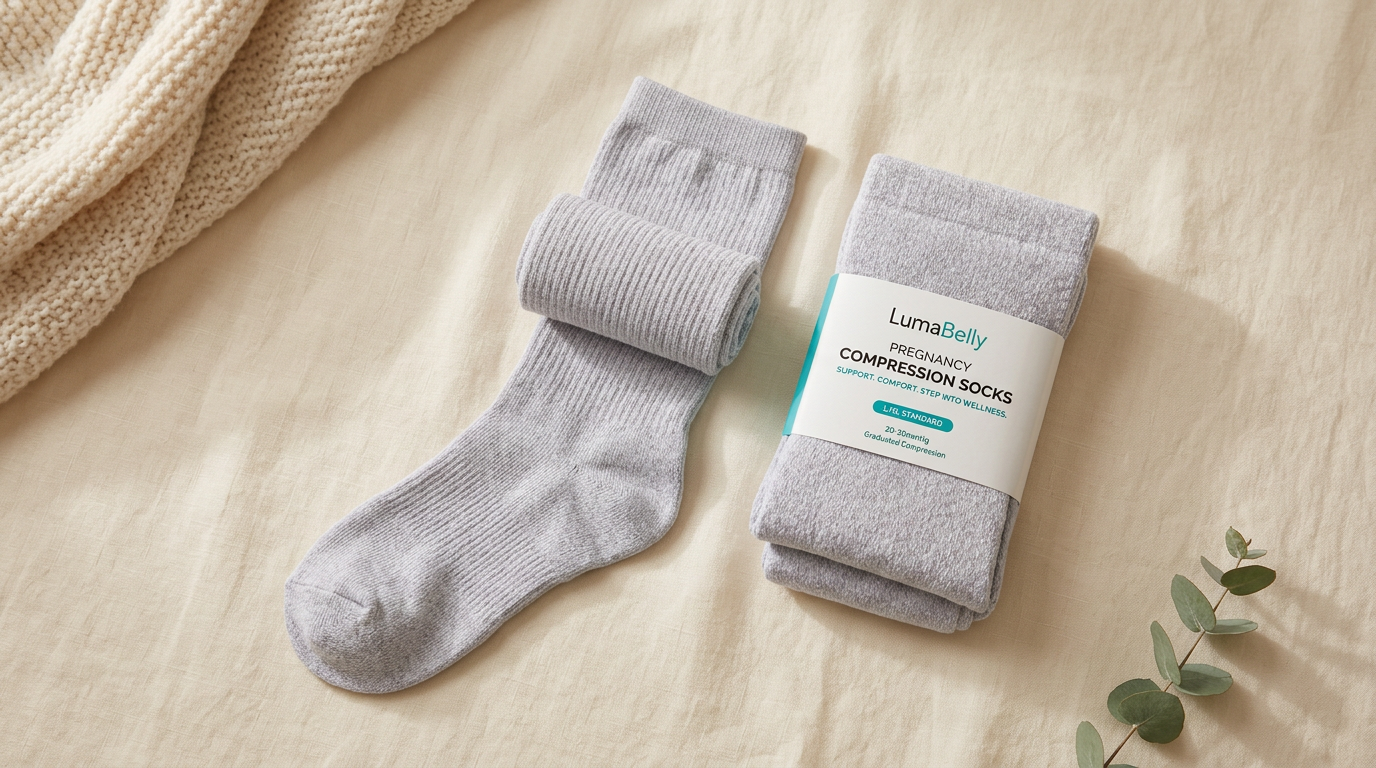
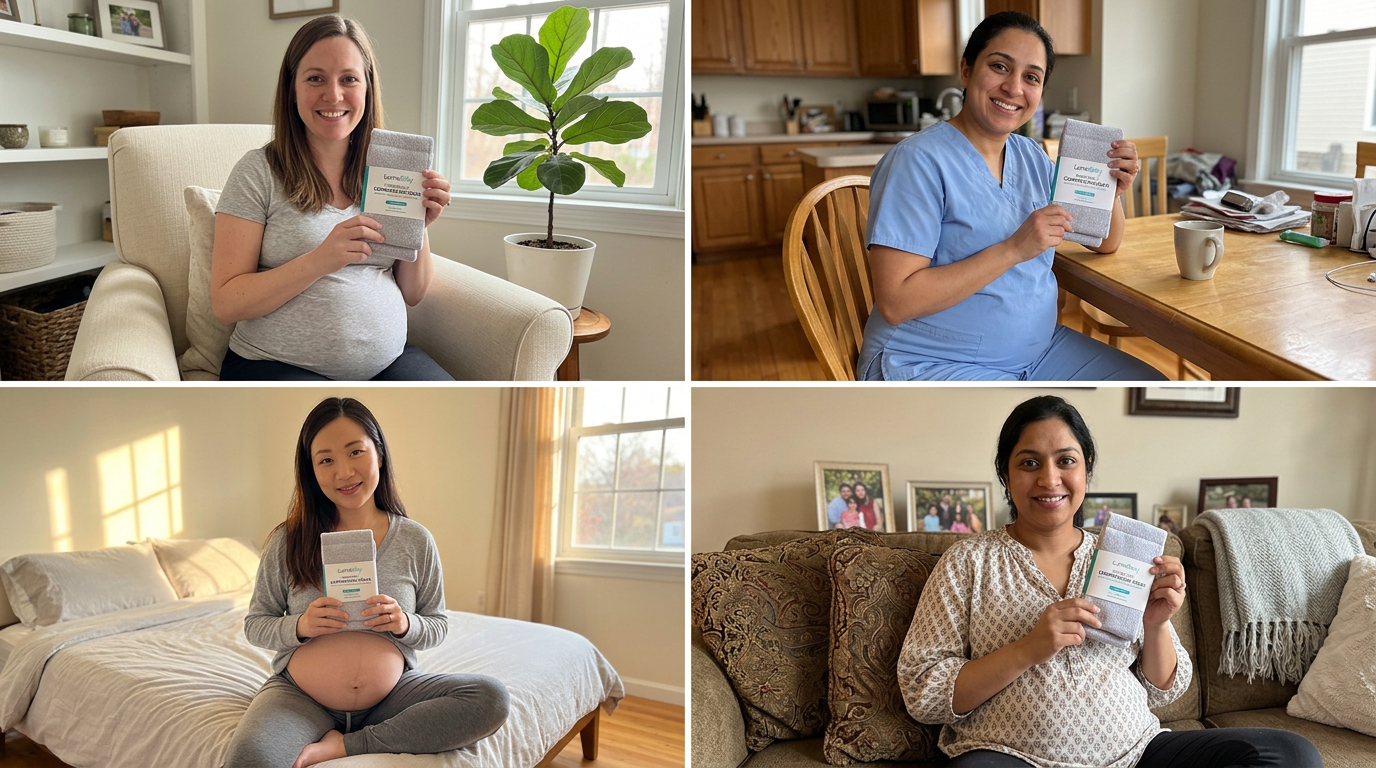
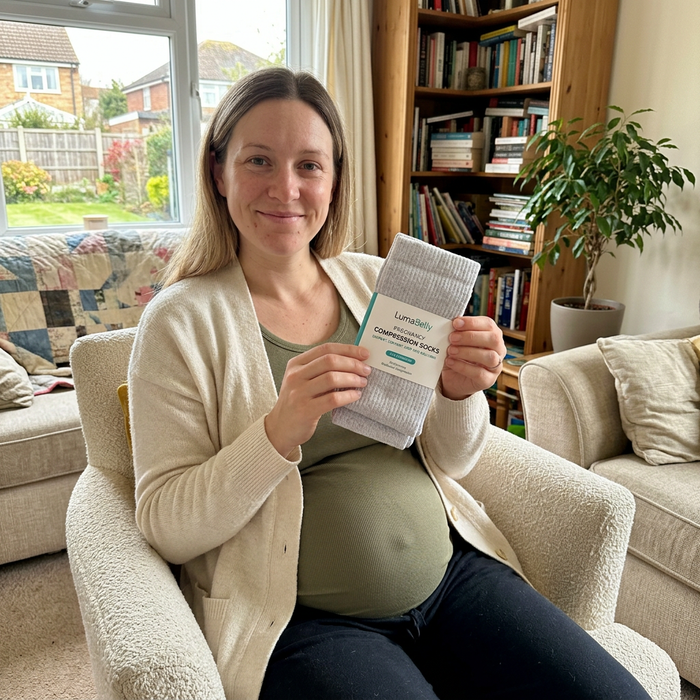
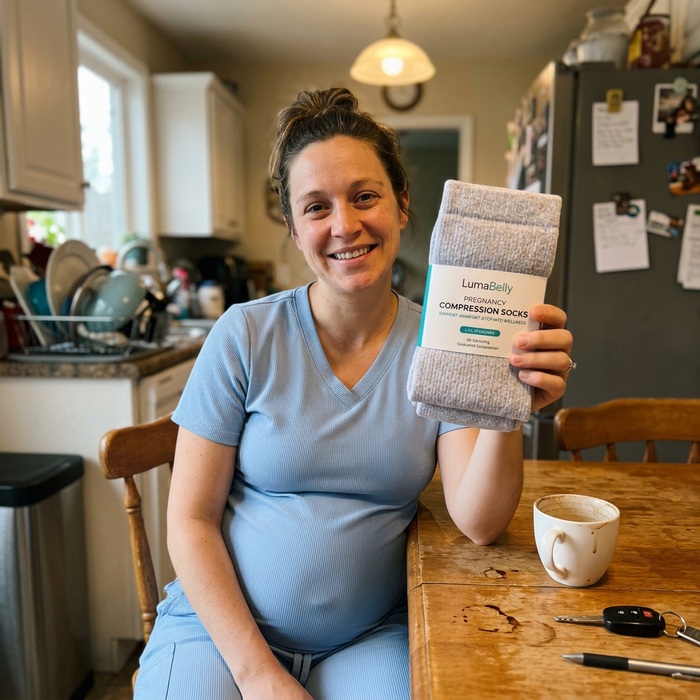
It's called LumaBelly Pregnancy Compression Socks. And it isn't the $12 two-pack off Amazon, and it isn't a flight sock with "maternity" printed on the bag.
WHAT MAKES IT DIFFERENT, PIECE BY PIECE
Here's what makes it the exception, and why each part actually matters.
Graduated 30 → 20 mmHg. Not a flat squeeze, a true gradient, calibrated for the extra blood of pregnancy. This is the part that moves the blood up and out instead of trapping it. It's the whole reason the sock works, and it's the exact spec most brands don't hit.
A soft bamboo blend. This sounds like a comfort detail. It's the most important feature on the list, because a sock that itches or overheats comes off by noon, and a sock that's off your leg protects nothing. Soft is what makes "all day, every day" actually happen.
Cut for a pregnant body. Wide enough at the calf, stretchy enough to pull on over a bump without a five-minute fight or your partner's help. Most "maternity" socks are a normal sock with the word printed on the packet. This one is shaped for the leg you actually have right now.
Built to last around 200 washes. The pressure you paid for has to still be there in your third trimester, the exact stretch when the pooling is worst, not gone soft after three weeks like the cheap pairs.
Put it on in the morning, before your legs start to swell, and wear it through the day. That's the entire routine. The earlier in your pregnancy you start, the more of your legs you protect.
WHAT A DAY IN THEM ACTUALLY FEELS LIKE
Here's what the day feels like, from the mothers who've done it.
You pull them on before your feet even hit the floor. A firm hug at the ankle, a lighter one up the calf. From that moment, the blood is being nudged upward instead of settling.
Through the day, the shift, the desk, the school run, the flight, the squeeze keeps working while you're upright, which is the exact stretch of hours that "put your feet up" can never help you with.
By evening comes the part they notice first: their legs don't feel like two sandbags, there are no deep red sock-lines carved into their skin, and the vein they've been watching hasn't crept any further than it had that morning.
WHAT THE FIRST FEW WEEKS LOOK LIKE
Here's the pattern, week by week, from the mothers who start early and wear them daily.
The first few days. The end-of-day heaviness eases. That sandbag feeling by dinner, the one you'd started to think was just part of being pregnant, lifts. You stop dreading standing up.
The first two to three weeks. The deep red sock-lines are gone, your ankles still look like ankles at night, and if you've been watching a vein, it hasn't crept any further than the day you started. That part is quiet, but it's the whole point.
Through the third trimester. This is the stretch when the pooling is at its absolute worst, when the blood volume peaks and the baby presses hardest. It's also when the socks earn their keep, holding the line every day through the highest-pressure weeks of the entire pregnancy.
None of that is a cure. It's something better and more honest: support during the exact window when it's the only thing that counts.
WORD GOT OUT, AND NOT EVERYONE WAS HAPPY
When mothers started keeping their legs, word spread. Other moms. The nurses on the maternity floors. A few colleagues who quietly ordered a pair for their own wives.
And then came the pushback. Never from patients, always from people whose income depends on those veins showing up in the first place. I was "overstating the risk." I was "undermining accepted treatment." Funny how not one of them ever argued with the results.
Let them be uncomfortable. I would rather ten thousand mothers keep their legs than keep one more waiting room full.
THE RESULTS MOTHERS ARE GETTING
Since mothers started wearing this pair early and every day, the pattern has been remarkably consistent.
✓ [XX]% report noticeably lighter legs within the first [X] days. [verify or cut]
✓ [XX]% watching an early vein say it stopped spreading while they wore them. [verify or cut, high claim]
✓ Most say it's the first compression they've ever actually kept on all day.
✓ Rated [4.8] out of 5 across [10,000+] mothers. [confirm your real number]
But the number that matters most to me isn't on that list. It's this: the mothers who start early, and keep them on, are almost never the ones I see back in my office a year later asking who does laser.
WHAT MOTHERS KEEP TELLING ME

Here's what they say in their own words.
"I'm six months pregnant and I'd been fighting swollen feet for weeks. The first morning I put these on I could feel the difference by lunch. I don't take them off now." Caroline T.
"I'm a nurse, I've worn every compression sock there is. These are the first pair I don't rip off halfway through a shift, and I have wide calves, so the small/medium fitting was a genuine shock." Berna D., RN
"I found a vein behind my knee at 28 weeks and panicked. Started these that week. Weeks later it hasn't spread, and I just wish I'd started the day I first saw it." Jordan L.
"My mom has varicose veins from both her pregnancies and I was terrified of the same thing. I bought these the day I saw my first spider vein. It hasn't gotten worse. That peace of mind alone was worth it." Priya S.
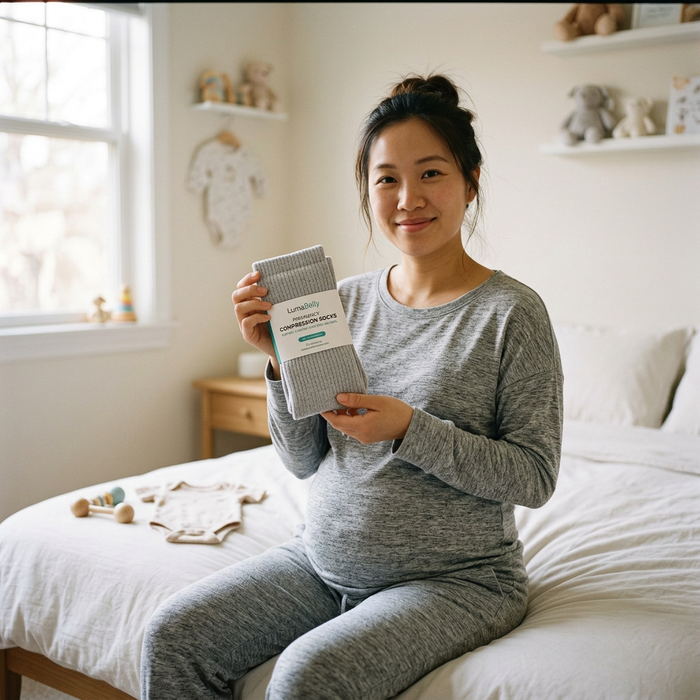
More than 10,000 mothers have made the switch. And the ones who start early are almost never the ones I see back a year later.
WHAT WAITING ACTUALLY COSTS YOU

Let me put the numbers side by side, since the clinics never will.
ROUTE 1 — Remove them later (after the vein sets):
- Sclerotherapy injections: about $350–$500 a session, usually 3 or 4 = $1,000–$2,000
- Laser or vein ablation: roughly $1,500–$3,000 per leg, and you have two = $3,000–$6,000
- Consults and follow-ups: $200–$400
- Filed as "cosmetic," so insurance pays: $0. You pay all of it.
Total: $4,000 to $8,000+, out of your own pocket.
ROUTE 2 — The cheap-sock churn:
- $12–$20 pharmacy pairs that roll down, itch, and die in a month, bought four or five times across a pregnancy = $60–$100, and you still end up avoiding them.
ROUTE 3 — Just manage it forever:
- Wedge pillows, creams, the leggings you buy so you can stop looking at your legs, and the quiet cost of covering them up every summer for the rest of your life.
ROUTE 4 — Support your legs now, before the vein sets:
- One pair of LumaBelly socks. Normally $59.99. Today, as part of a 72-hour sale, 50% off.
$59.99 → $29.99. Once.
That's not a comparison the vein industry wants you to see. Because remember how their business actually works: to a vein clinic, you are not a patient. You are a laser appointment they haven't booked yet. Every mom who supports her legs at home for $30 is money they never collect. That is the entire reason "it goes away after the baby" is the most repeated sentence in that waiting room.
⚠️ TWO CLOCKS ARE RUNNING
There are two deadlines on this, and only one of them is in my control.
The first: the 50% price holds for 72 hours, then it goes back to $59.99.
The second, the one I can't move for you: your pregnancy ends on a date you already have circled, and the window to keep these veins from setting closes on the very same day. Every morning without support is one more morning the blood sits and presses on that wall. Same vein, same spot, a little closer to permanent.
And one honest word about stock: these have sold out seven times, and we only sell them here, because the cheap copies with the wrong pressure are the exact useless socks I've spent this whole page describing. If you can see a price below, there's still stock right now.

Of the two clocks, watch the second one. The sale is a reason to start today. The window is the reason you can't start "after the baby," because after the baby, the swelling leaves and the vein stays.
MY 30-DAY "KEEP YOUR LEGS" PROMISE

You've bought pregnancy things that ended up in a drawer. So have the women I see. So here's the promise, in writing.
Wear them every day for 30 days. Put them on each morning, wear them through the day, and watch how your legs feel by evening and whether that vein has moved.
If your legs don't feel lighter and better supported, email us your order number and the word "refund," and you get every penny back. No forms, no argument, no restocking fee.
One thing I have to say as a doctor: normal pregnancy swelling comes on slowly and evenly. If one leg suddenly swells, or a leg turns painful, red, or warm, that is not a job for a sock. Call your doctor that day.
THE TWO VERSIONS OF NEXT SUMMER
Tonight you're really choosing between two versions of yourself a year from now.
In the first, you took the usual advice and waited. You delivered your baby, the swelling went down right on schedule, and the veins stayed exactly where they were. Now it's summer, you're deciding which dresses hide the backs of your legs, and there's a folder somewhere with a laser quote you keep trying to talk yourself into.
In the second, you put a pair of socks on tomorrow morning, kept them on through the months the pressure was highest, and gave that blood somewhere to go every single day. Your legs look like they did before. You don't think about them at all.
Only one of those is still open to you, and only while you're pregnant.
HOW TO START
Step 1: Tap the button below.
Step 2: Choose how many pairs. Most moms don't want to get caught mid-week without a clean pair:
- 1 PAIR — $29.99 (50% off). Enough to feel the difference your first week.
- MOST POPULAR: 2 PAIRS — [$XX.XX] + FREE shipping. One on, one in the wash, so you never skip a morning. (Two pairs clears the free-shipping line; one doesn't.)
- BEST VALUE: 3 PAIRS — [$XX.XX] + free shipping. The whole pregnancy covered, plus a pair for postpartum.
Step 3: When they arrive, put them on the very next morning, before your legs swell, and wear them every day after that.
Whatever you do, don't close this and tell yourself you'll deal with it after the baby. There is no "after the baby" for this. After the baby is the swelling leaving and the vein staying, and a bill I'd rather you never have to pay me.
The window where your legs are still yours to keep is open right now, and it closes on a day you already have circled.
[→ Check availability, 50% off while stock lasts]
To your legs, and a summer you never have to think about them once,
Dr. Elise Moreno
Vascular & Vein Specialist
P.S. The window to keep these veins from setting closes the day you give birth. The mothers who start early are the ones who never end up in my chair asking me to undo it.
P.P.S. The 50% price lasts 72 hours. Your window lasts until you deliver. Don't spend the second one waiting on the first.
P.P.P.S. If a clinic ever tells you nothing could have been done about your legs, remember who pays their bills. You have the truth now, while you can still use it. Most mothers never get it in time. You did.
P.P.P.P.S. One pair is the price of a lunch out. A laser session is the price of a used car. You are choosing between them right now, tonight, whether you decide to or not.
[→ Check availability — 30-day keep-your-legs guarantee]


Up to 84% of mothers walk out of the delivery room with varicose or spider veins they will have for life, and almost none were ever told it was avoidable, or that the one window to act closed the day they gave birth.

It is not bad luck and it is not bad genes. It is 50% more blood, gravity, and months of pressure stretching the vein walls until they surface. Graduated compression (30 mmHg at the ankle, easing to 20) is the one thing that moves that blood before it does the damage.

The vein-removal industry only gets paid after the vein has already set. That is why "it goes away after the baby" is the advice you hear, and why the moms who start early are the ones who never become their customers.
What mothers are saying: